Well, I've tried to find official definitions, but they don't help much.
Here they are:
The coat should be double, the outer consisting of long, straight, harsh (coarse) hair; the undercoat short, furry and so dense as to give the entire coat its “stand-off quality.
Faults: Coat short or flat, in whole or in part; wavy, curly, soft or silky. Lack of undercoat
“Harsh” if it tends to repel water (note that some will interchange harsh and coarse) Some coats are profuse but soft and fluffy. While these may look impressive, they are harder to maintain and are a disadvantage to a working dog because they soak up water like and sponge and tangle easily in the underbrush.
Coarse or harsh does not mean “dry”. Shelties coats should be protected from the sun with UV conditioners if they are outside for extended periods. A tri’s black coat will bleach red if sun-damaged.
The Shetland Sheepdog Breed Standard defines the beautiful Sheltie coat as a thick, double coat consisting of long, straight, harsh (coarse) hair. The undercoat is short and furry, and so dense as to give the entire coat its "standoff" quality. The mane and frill are abundant, and should be particularly impressive in males, while the forelegs are well feathered. The hind legs above the hocks are covered profusely with hair; and below the hocks are fairly smooth. Smooth-coated Shelties are highly undesirable.
The Shetland Sheepdog has a thick, weather-resistant, double coat. The outer coat is long, harsh textured and straight. The undercoat is soft, short, and dense. The coat stands away from the body and is noticeably more profuse on males than females. The neck is heavily coated forming an impressive mane, frill and apron. The front of the forelegs are covered with short, smooth hair while the back sides are well feathered. The rump and hind legs down to the hock are covered with thick hair that forms the characteristic “trousers.” The tail is richly plumed. Hair on the face, tips of ears, feet and hocks is smooth. Trimming of these smooth areas is allowed.
Faults: Short or flat coat; absence of undercoat; wavy, curly, soft, or silky texture.
Disqualification: Smooth coat.
Smooth coat seems to refer to short haired variety and mostly limited to Collies.
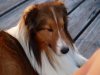
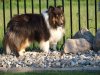
My takeawy on this is that Bacca has the proper harsh overcoat, but still lacking in thick undercoat. Indy has the undercoat, but despite how lovely he feels, his soft overcoat would be a fault.
In the weather category, its hard to say he performs better. I can dunk Bacca in the river and his undercoat won't get completely wet because his guard hair protects him. At the the same time, his guard hair is harder to dry.
If I plunk Indy in the river, he's saturated in a moment, but he dries quicker because he has the silky fur, not the harsh guard hair.
When I run my hands down them, Indy is soft. Bacca is definitely harsh.
These are not perfect pictures, but if you look close at Bacca's coat you see the guard hairs have abit of wiry texture to it. Indy on the other hand is all fluff.
Seems like Bacca is closer to standard, even though Indy's thick coat seems to photograph better.
Hope this helps!




 Is there any way to get a soft coat more harsh?