

showyness

White patterns

There are at least three genes that effect white in Shelties. The first and easiest to recognize is the Irish Pattern, which is collar, belly, tail and legs. This gene is also found in Collies, Beardies, BC's, Basenjis, etc.

The second is what we call "white-factored". Dogs who carry this generally (but not always) have white up the stifle on the rear legs. This is the gene that when doubled up produces correct color headed whites.

The third is called "piebald". Piebald dogs are the ones that have white and color interspersed all over the body. Extreme piebald is seen in Dalmatians. There are dogs who are called "color headed whites" who are actually piebald. The difference is that a correct color headed white is exactly that; white body, colored head, maybe one or two small body spots. Piebald dogs will have a colored body with big splashes of white, sometimes pushing them over the 50% white mark. Those are not true color headed whites. I would also assume that an otherwise colored dog with a white body spot carries the piebald gene. They might ALSO be white factored, though.

So to answer the original question, I don't think it matters if the front legs don't match. It can be distracting to watch, but a good judge can get over it.
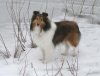
 
I was told by some show people that my girl Belle would be hard to finish in Akc because she was marked too much like a border collie. That most judges dont like a blaze on the bi-black. That I should hire a proffessional handler. Which is one of the reasons why I never showed Belle when she was younger, I didnt start showing her until she was 2 and with Ukc. I was nervous and couldnt afford a handler, plus I couldnt find any handling classes near me. Luckly I found a breeder willing to help me out.

I have also been told that its a good that Dusty has a collar on his show side. (He only has half a collar)

As much as people say color doesnt matter I have heard complaints time and time again about judges that like certin colors over others. As a matter of fact wasnt people just saying how the westminster judge only put up blues?

I am not saying all judges are like that, I know there are judges out there that do judge on structure and dont worry about color or markings. But there are also some color oriented judges out there too.
 
There are at least three genes that effect white in Shelties. The first and easiest to recognize is the Irish Pattern, which is collar, belly, tail and legs. This gene is also found in Collies, Beardies, BC's, Basenjis, etc.

The second is what we call "white-factored". Dogs who carry this generally (but not always) have white up the stifle on the rear legs. This is the gene that when doubled up produces correct color headed whites.

The third is called "piebald". Piebald dogs are the ones that have white and color interspersed all over the body. Extreme piebald is seen in Dalmatians. There are dogs who are called "color headed whites" who are actually piebald. The difference is that a correct color headed white is exactly that; white body, colored head, maybe one or two small body spots. Piebald dogs will have a colored body with big splashes of white, sometimes pushing them over the 50% white mark. Those are not true color headed whites. I would also assume that an otherwise colored dog with a white body spot carries the piebald gene. They might ALSO be white factored, though.

So to answer the original question, I don't think it matters if the front legs don't match. It can be distracting to watch, but a good judge can get over it.

Here is a photo of Sadie, who we believe is white factored.
 

Attachments

  • IMG_0849c.jpg
    IMG_0849c.jpg
    35.8 KB · Views: 21
Could be white factored.

I have two dogs who have white stifles, but only on one leg. So I have no idea if they are white factored or not. One has been bred, and none of his puppies have white stifles. I plan to breed the two on her next season, so we will see what happens. :smile2:
 
I've always been a bit confused on the color headed thing. Do you have any good pictures that would demonstrate it very clearly to me? Still somewhat new to the color thing(which is why I'm staying away from merles to start my breeding program.
 
I've always been a bit confused on the color headed thing. Do you have any good pictures that would demonstrate it very clearly to me? Still somewhat new to the color thing(which is why I'm staying away from merles to start my breeding program.

This page has some nice examples:
http://www.norcalshelties.org/SheltieColors/whitemarkings.html#anchor_182

It would be good to point out that there are two kinds of "white' Shelties: the first, illustrated above, are color-headed whites. This coloration is NOT caused by the merle gene. There are no health issues associated with color-headed whites - their eyesight and hearing are not affected by their coloration. Color-headed whites can be sables, merles, blacks - any sheltie color. They can't be shown in AKC, but they are happy, healthy dogs.

The other kind of white Sheltie is the homozygous white, or "double-merle", or "double-dilute". These dogs do not have colored heads (or have limited coloring on the head), and their coloration is caused by a "double-dose" (one from each parent) of the merle gene. They usually have vision and hearing problems, in addition to being unacceptable in the AKC conformation ring.

Here is a German site that has some classic photos of homozygous white Shelties.
http://www.chw-shelties-germany.com/doublemerle.html
 
The other kind of white Sheltie is the homozygous white, or "double-merle", or "double-dilute". These dogs do not have colored heads (or have limited coloring on the head), and their coloration is caused by a "double-dose" (one from each parent) of the merle gene. They usually have vision and hearing problems, in addition to being unacceptable in the AKC conformation ring.

Yea, thats why I'm staying away from merles for now, that whole hidden merle gene is a little worrying to start out with. I'll try my hand in them when I have a bit more experience.


And on a somewhat different topic, has anyone ever ended up, on accident of course, with a lethal silver in a litter? Its something I'd like to avoid at all cost. Perhaps a specific line that is more susceptible to have them than others? Perhaps a Romayne over Macdega or something. . . I havn't found much on it, just that it exists.
 
And on a somewhat different topic, has anyone ever ended up, on accident of course, with a lethal silver in a litter? Its something I'd like to avoid at all cost. Perhaps a specific line that is more susceptible to have them than others? Perhaps a Romayne over Macdega or something. . . I havn't found much on it, just that it exists.

I have not heard of an actual case of Lethal Silver in Shelties since I got into them. http://www.pennylanecollies.net/GrayCollieSyndrome.html is a good website about them. There is a test for it in Collies. I know there is one Collie named Sugar who is a lethal silver who is almost 5 years old, so the treatments are getting better as well.
 
Back
Top