
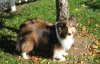
what color is this beautiful dog considered?

Well sometimes it is hard. Sables can carry only one black gene either tri or bi. If you have a sable with a black parent and a sable parent. The sable gene came from the sable parent and the black gene came from the black.

If the black dog is a bi you know that your sable is bi factored as there is no other option. However, if the black parent is a tri then is depends on what black genes they are carrying. You know there is a tri gene as they are tri but the other gene(the hidden gene) could be a tri or a bi depending on what their parents were. So which one did your dog get? Sometimes you don't know unless they are bred and produce a bi pup. It can be just as unclear if the parents are sables as the black gene is hidden. You really need to look at the pedigree and then still might not know. Confusing.

Here is my example:

Diva is a tri(Tri/?). Her mom is a mahogany Sable(S/?) same color we are talking about. Mom's parents were a pure for sable and a Bi factored Tri(Tri/Bi). So mom could be a Bi factored or Tri factored Sable we don't know. She has only been bred to a black dog(bi factored Tri) once and 2 Tri produced so we still don't know as the tri gene could have come from the dad. If Diva produces a bi we still don't know as again she could have gotten the bi gene from dad but if she never produces a bi pup when bred to a bi factored dog there is a good chance that she is Tri/Tri and mom is tri factored. The way to straighten it out for sure would be to bred mom to a Bi black if a Tri is produced , you know Mom is a Tri factored Sable. Make sense?

To give you idea how hard it is to determine if a dog is bi factored. Ember's(Bi/Bi M/m) mom is a bi factored Sable(S/Bi). Her dad a blue merle(Tri/Bi M/m). None of his parents were Bis and none of his 4 Grandparents were Bis. The bi gene come from his great grandsire, Ember's great great Grandsire. It skipped down that many generations unknown before it showed up again.


Wow, I had no idea it was this complicated. I knew there were tri-factored and bi-factored, but I though it just depended on their parent. Like I mentioned earlier with Meggie. I'm not sure I understand all of it, but it is very interesting!
 
wow!! who wouldve thought it was like humans kinda lol! i got my uncles blue blue eye and wavy hair, where my mom has straighter hair and green eyes. i guess with jake, i wont ever know, since he was a petland dog. but he has the black, so i dont know if he is the mahagony tri factored, or a shaded sable tri factored. he is just pretty that i know lol! i know belles parents were both tri's where the father has the goregous markings on his face with the gold and the black mask which i totally love that mask. her mom was almost all black and white but the breeder said she had gold on her face, which you dont see in the photo. her sister got the blaze down her face, with a little gold and no black mask. her brother looked like belle with the black mask. so i know bell is a tri, but i guess she could have the bi gene then? all i know is that she has grey blue fur down her back, and on her head so the comb tells me when i looked at her fur when i took it out of the comb. you know whats weird is she has a blue hue to her eyes still at almost 11 weeks, like a blue brown. does that go away later down the line? so now im curious and dont take this the wrong way, im just curious if i bred a tri with grey blue fur and a mask, with a shaded sable or mahagony with black, so tri factored? what color patterns would that produce? (im not breeding with belles possible disorder just curious).
 
To me, a bi-factored sable will always have the smutty smudge of gray black around their eyes and down their muzzle. Also, a bi-factored sable is a dull washed out coloring. I think of mahogany as only a true tri-factored sable, where the color is clear and rich. For us, dogs are referred to as tri or bi factored. It gives an instant picture in our mind. Also, a bi factored tri will have dull tan points, not the rich orange sable.
 
To me, a bi-factored sable will always have the smutty smudge of gray black around their eyes and down their muzzle. Also, a bi-factored sable is a dull washed out coloring. I think of mahogany as only a true tri-factored sable, where the color is clear and rich. For us, dogs are referred to as tri or bi factored. It gives an instant picture in our mind. Also, a bi factored tri will have dull tan points, not the rich orange sable.


Missjenneygirl; would you consider Meggie a tri-factored sable?
 

Attachments

  • Meggie 10.18.09. 011.jpg
    Meggie 10.18.09. 011.jpg
    62.5 KB · Views: 31
The bi factoring can hang out for a few generations without anyone really knowing it's there. Case in point:

A litter has four puppies, three tris and a sable. We know the dam is a tri-factored sable. It had always been assumed (I guess) that her sire was a tri factored sable. And actually, if you look at his page on pedigreelines, it still lists him as a tri-factored sable (http://pedigreelines.com/dog/show/name/lakehill-king-o'-the-road). His sire was a bi-factored sable, and his mother was a tri-factored sable, so he could be either.

Anyway, life goes on. Owner (correctly, as it turns out) assumes the three tris in her litter are all bi-factored. People doubt. One of the tri bitches is bred to a non-bi factored dog. She produces two puppies, a blue girl, and the smuttiest tri boy you have ever seen (his name is Patton). Still, people doubt. Patty Page breeds a bi-factored blue to Patton, and guess what? Out pops TWO bi-blue girls. Patton is bi-factored, and when you trace back the pedigree, it leads right back to the dog everyone believes is tri-factored.

I love working out color stuff like this. Nothing better than a good puzzle.
 
Back
Top