Handling systems????

I got 'Great Dog, Shame About the Handler' which seemed to be the most appropriate for where we are at the moment (and a title which appealed having used it for one of my threads a while back when I discovered HAHA!:wink2:) It's a very enjoyable education - can you ever watch/read too much agility?! :lol:

I don't want to go back to the days of 'over,over,over' but I can see verbal cues are important for obstacle discrimination, to support motion cues and also giving feedback to the dog. I dislike our higher obedience classes for the reason the dog is expected to heel for extended durations with no encouragement. It's not a question of whether the dog can do it but I've found utter silence seems to make them stress. I like to give a motivatonal 'yes' for something like a nice corner and I found with weaves that once we were proofing harder entries the 'yes' gave the feedback the entry was right and the reward was for doing 12. I like the 'yes' as both Epic and Yogi have learned this means 'you're doing great, carry on.'

I'm now looking at mine and Epic's strengths and weaknesses (latter are mostly me not being a human compass!) to see what style(s) are going to suit us best. I think it's probably best if we play to our strengths and what comes most naturally rather than trying to shoehorn ourselves into a particular method for the sake of it. Also looking at the type of courses we're going to be running as no point fixating on doing something which is less suited to UK competition.

I remember you posted a link to the ST article a while ago and it is interesting to read it again with a bit more experience and knowledge. I feel she makes a valid point, but on many of the courses I've seen here (lower and higher grades) it seems that a certain amount of handling from behind/afar is going to be essential as there are much longer distances between obtacles and a lot more straight lines. I don't know if the age range of competitors in Europe is as wide as it is in the UK- most people competing in agility that I know are senior citizens!
 
not sure if this was shared yet... I mighta missed it

http://www.lolabuland.com/2013/10/01/too-slow-for-your-dog-2/

How aptly timed, one of the reasons I have evolved and working on the way I train and handle agility... Naturally I am still a work in progress, but makes sense to me.
Obviously you have to train with that mindset, and teach your dog that way but it can be done and I just love her attitude...

So glad my trainer always learns new things and is open to changing even when I wasn't :D hahaha she keeps straightening me out!
 
Ah: timing is oh so important. Clearly it was easier for observers with a keen eye to read Koji's commitment from a distance than for you where you were.

Y'know, I never truly knew how much people could see what Koji is capable of (especially in the past 2 years of trialing) and that I'm the one that held him back most of the time. I think this new trainer, is the first, who within one training session, knew all of our strengths and weaknesses. That impressed me a lot. Regardless if the other trainer I went to, knew or not, she never said.

Since that Daisy seminar, I started to give Koji more freedom and trust in him a lot more. We grew as a team a lot after that.
 
Yes, OneMind I believe is from Finland.
The funny thing is from my perspective the changing attitude out west towards applying handling strategies that primarily use motion has been driven by the masses & not by the trainers.
As has been mentioned out west most trainers were GD based.
Have you noticed how much more information on handling systems like APHS are available today than there was 5 years ago, or even 3 years ago?
There are many more international handlers coming over to the USA for seminars or even extended stays (e.g. DW) & they are sharing a range of systems that rely on motion-based handling.

IMHO some (former-GD) trainers have been compelled to deepen there own understanding & skills as they apply to these motion-based systems because their students are educating themselves.

To add to this hasn't SG a little while back mentioned how she had been working in "new" handling --- yep: I've watched some videos & she too appears to have seen the light. Someone even mentioned the evolution of GD's system has started to consider motion --- wasn't there some surprise when he used a BC in some competition? Even take jump training: originally SS's jump foundation did not consider motion - and that has also changed somewhat.

So true. Back when we started in 2008, everything was GD. The only reason I had heard of Linda M was because my trainer would use her system for a physically challenged woman in our class. Maybe I should have paid more attention, LOL. So obviously, she knew APHS, but enforced GD.

I do have to laugh about this.....my trainer didn't want any of us doing Rally because y'know, the dog goes behind you. Don't want them to think it's okay. Hehehe. I still don't think it would have mattered.

I know with my new trainer, ugh, she puts a lot of back-side jumping into our training. Makes me realize I have no training in that at all and need some. LOL. It's amazing how those "international" courses are all over here now. Honestly, even if it's difficult because we didn't train for it, I'm enjoying the challenge.

I'm so amazed at how much things have changed since we started. From handling systems to courses. Just amazing.
 
I really like Cheryl's suggestion of trying out different methods to see what works best. I hadn't thought of that but it makes sense as on the whole it seems you don't have to really teach the dog what the cues mean as they respond instinctivly to certain movements (as per the research and One Mind) so I would get a fair idea of what is going to suit us. One thing I am going to avoid though is doing something that generates barking no matter how good it is!! :lol: Got to think of the neighbours!

I have picked up from comparing videos of different handlers' runs over the same international course is the motion systems appeared to get smoother runs with less gasps of concern from the crowd :lol:. I don't know whether they were quicker though. I'm going to look at some clips from the International invitation class at Crufts to see whether the same was true on our more open courses.

I think these two summed up what I learned. I do think you should learn some sort of consistent foundation so the dog understands what it's job is. That doesn't mean you can't piece meal it together, it just means foundation is important. Even now, I can see that my BC's (in training) are starting to make Koji go behind me to take obstacles, even if I don't want him to. Time to reinforce what I want from him. He's getting confused. Even the trainer picked that up.

Watching this one difficult part in the USDAA Masters Challenge this past weekend, it's interesting to see how people decide to handle it. And yeah, some ways looked a lot smoother and therefore easier than others. Mine was horrible, but that's because I screwed up big time and that I don't have the training for back-side jumping. Need to teach that. Cik/Cap may come in handy. :)

And as has been mentioned, the agility world has changed a lot, in terms of handling and courses. All this back-side jumping, I don't know how GD would handle that. Obviously I never learned it.

And that is why I like, in practice, that my trainer will say, "try it this way, let's see if it's any faster/easier". Even if we didn't train a certain move, just trying it is so much better. Granted, not sure if that's okay for a new dog or not.

Lastly, the barking, well..........why does the dog bark? Is the dog telling you off? If I perform well, Koji won't bark. That means I'm giving him directions at the right time and not confusing him. He barks at me when I screw up or don't give him directions early enough, etc. So you see, when Koji barks, I know it's my fault. :rolleyes2:
 
Lastly, the barking, well..........why does the dog bark? Is the dog telling you off? If I perform well, Koji won't bark. That means I'm giving him directions at the right time and not confusing him. He barks at me when I screw up or don't give him directions early enough, etc. So you see, when Koji barks, I know it's my fault. :rolleyes2:

That is SO true! Epic never barks when he's running - and he is a really barky dog normally. I think when he is concentrating it leaves no room for barking! :lol: If he does bark on a run then it's through frustration because he is confused. He barked loads when we started on the 2x2s but never now (apart from when I'm setting the weaves up).

I've noticed that dogs that bark constantly when running a course seem to be more likely to go wrong, even at the top level...

PS What is backside jumping? I think dog going to the back of a jump (not jumping handler's butt!:lol:) but I can't picture what this would look like. Is it a 270 turn?
 
Last edited:
Areas of confusion?

I would love your thoughts on this:wink2::

I've been training Epic for a rear cross (on jumps) and with all the different handling systems the point still seems to be handler crosses behind = dog switches direction as handler completes the manouver.

But Rear crossing the weaves seems to be contradicing this training? I practiced this for the first time with Epic yesterday and the first few times I tried he flipped out on the 'new side' as I moved accross. I thought he was just being distracted by me but on reflection he was just doing what he's been trained to do - respond instantly to me changing sides. After a few tries though he got the idea and stayed in. :smile2:

I guess with weaves and also the contact equipment then the dog has to 'unlearn' the instant RC jump behaviour and learn to stay going in the original direction until the obstacle is competed? I imagine that for this reason there is value in having a supporting verbal/arm cue for jumps to get a quick turn rather than expecting the dog to respond in a different way to the same cue?

Different question:
On watching the International competition videos I saw some of the handlers using the motion type of handling were bending over a lot but I keep getting told off for bending over as it pushes the dog out?

I spent a happy couple of hours watching some One Mind and Linda Meckleburg DHS videos last night. Lots to like :smile2:
 
I would love your thoughts on this:wink2::

I guess with weaves and also the contact equipment then the dog has to 'unlearn' the instant RC jump behaviour and learn to stay going in the original direction until the obstacle is competed? I imagine that for this reason there is value in having a supporting verbal/arm cue for jumps to get a quick turn rather than expecting the dog to respond in a different way to the same cue?

Different question:
On watching the International competition videos I saw some of the handlers using the motion type of handling were bending over a lot but I keep getting told off for bending over as it pushes the dog out?

Question one- yes, you would strive for independence on contacts and weaves, this is why it is hard to teach because you asking dog to do exactly what you taught him not to do:smile2:
Question two- depends how you run faster:lol:
 
PS What is backside jumping? I think dog going to the back of a jump (not jumping handler's butt!:lol:) but I can't picture what this would look like. Is it a 270 turn?

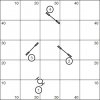
A backside jump is where you have to push the dog around the jump and take it from the opposite side of normal flow. Here is a sample of what a backside jump would look like. Obstacles 1, 2, and 3 would be front side jumps - jumps taken in the normal flow. Obstacle 4 is a backside jump - you have to push the dog around the jump to the back of it and jump it opposite the line you were originally running.
 

Attachments

  • OffSideJump.JPG
    OffSideJump.JPG
    23 KB · Views: 6
But Rear crossing the weaves seems to be contradicing this training? I practiced this for the first time with Epic yesterday and the first few times I tried he flipped out on the 'new side' as I moved accross. I thought he was just being distracted by me but on reflection he was just doing what he's been trained to do - respond instantly to me changing sides. After a few tries though he got the idea and stayed in. :smile2:

I guess with weaves and also the contact equipment then the dog has to 'unlearn' the instant RC jump behaviour and learn to stay going in the original direction until the obstacle is competed? I imagine that for this reason there is value in having a supporting verbal/arm cue for jumps to get a quick turn rather than expecting the dog to respond in a different way to the same cue?

This is why having independent weaves and contacts are important. The dog needs to understand their job is to complete the weaves and contact obstacle regardless of what the handler is doing.

Rear crossing on the weaves and contacts takes practice since until this point you haven't done that "trick" which them. Keep working at it and keep working on the independent performance of the obstacles. It will come together.
 
Back
Top